
Emergencies rarely unfold exactly as expected. Whether responding to a large-scale fire, a violent incident, a medical emergency or a natural disaster, first responders must make rapid decisions while working under significant pressure. Public safety training technology is helping agencies prepare for these demanding situations by providing new ways to develop practical skills, strengthen decision-making and improve coordination before personnel face real-world emergencies. Rather than replacing traditional instruction, modern technology is enhancing it by creating more immersive, repeatable and realistic training experiences.
As public safety organisations continue to face evolving risks and increasing operational demands, investment in advanced training solutions has become a priority. From virtual reality and interactive simulations to digital incident management exercises, technology is changing how police officers, firefighters, emergency medical services and other responders prepare for the challenges ahead.
Moving Beyond Traditional Training Methods
Conventional training remains essential for developing the core skills every responder needs. Classroom instruction provides the theoretical foundation, while live exercises help personnel practise operational procedures in realistic environments.
However, organising large practical exercises often requires significant planning, specialist facilities and considerable resources. Certain incidents are also difficult—or impossible—to recreate safely.
Modern training technology helps fill these gaps by allowing agencies to simulate complex situations without the same logistical challenges. Participants can experience realistic incidents while instructors maintain complete control over the environment and learning objectives.
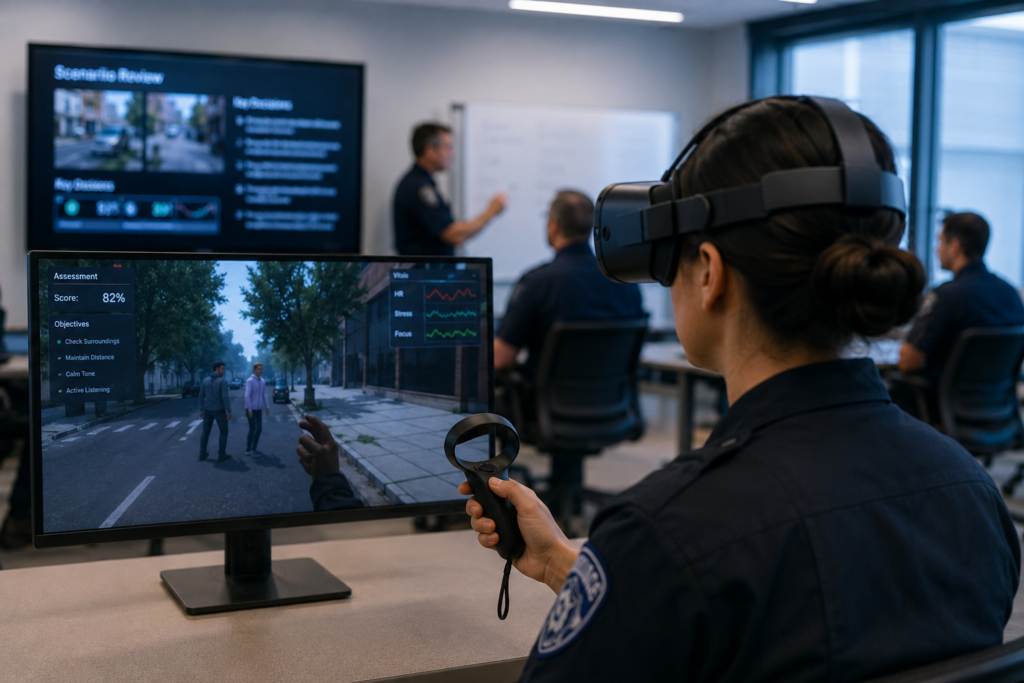
Creating Realistic Emergency Scenarios
One of the greatest strengths of technology-based training is its ability to recreate situations that closely resemble real operational environments.
Participants may find themselves responding to a large public event, managing an active threat, coordinating a rescue operation or handling multiple casualties following a major collision. Environmental conditions, crowd behaviour and unexpected developments can all be incorporated into the exercise.
Because these scenarios evolve in response to participant decisions, responders learn to think critically rather than simply following a predetermined sequence of actions.
This type of experiential learning helps build confidence before personnel encounter similar incidents in the field.
Strengthening Decision-Making Under Pressure
Emergency responders often have only seconds to assess information and determine the most appropriate course of action.
Technology-based simulations expose participants to controlled levels of stress while allowing instructors to evaluate how decisions are made throughout the exercise. Rather than focusing solely on technical skills, training also develops situational awareness, communication and leadership.
After each scenario, responders can review their actions in detail, discussing what worked well, where improvements could be made and how alternative decisions may have changed the outcome.
This immediate feedback encourages continuous learning while reinforcing sound operational judgement.
Encouraging Multi-Agency Collaboration
Many emergency incidents require cooperation between several organisations.
Police, fire services, ambulance crews, emergency planners and other agencies must communicate effectively while coordinating their individual responsibilities. Training these partnerships through large live exercises can be expensive and difficult to organise regularly.
Technology allows multiple agencies to participate in shared scenarios that test communication, command structures and resource management without requiring a major operational deployment.
These collaborative exercises help identify strengths, improve coordination and highlight opportunities to refine joint working arrangements before real incidents occur.
Making Training More Accessible
Operational demands often make it difficult to release large numbers of personnel for extended training sessions.
Digital training platforms provide greater flexibility by allowing agencies to deliver structured learning in a variety of settings. Depending on the technology being used, participants may complete exercises individually, in small groups or as part of larger coordinated training events.
This flexibility enables organisations to provide more frequent learning opportunities without disrupting essential frontline services.
Regular exposure to realistic scenarios also helps reinforce important skills that may otherwise receive limited practice.
Supporting Continuous Professional Development
Learning does not end once a responder completes their initial training.
New threats emerge, procedures evolve and technology itself continues to advance. Public safety organisations therefore require training systems that can adapt alongside changing operational requirements.
Modern platforms allow instructors to update scenarios, introduce new challenges and modify learning objectives without redesigning entire training programmes.
This adaptability ensures personnel continue developing throughout their careers while remaining familiar with current best practices and emerging risks.
Improving Confidence Before Real Incidents
Confidence is built through preparation.
When responders have experienced a wide range of realistic situations during training, they are often better equipped to remain calm when facing genuine emergencies. Familiarity with decision-making under pressure reduces uncertainty and allows personnel to focus on solving problems rather than reacting to unfamiliar circumstances.
Technology cannot replicate every aspect of operational experience, but it provides valuable opportunities to rehearse critical incidents repeatedly in a safe environment where learning can take place without real-world consequences.
Looking Ahead
As emergency services continue adapting to increasingly complex operational demands, technology is becoming an integral part of professional training. Agencies are recognising that effective preparation requires more than theoretical knowledge alone; responders also need practical experience making decisions in realistic environments before those decisions carry real consequences.
Public safety training technology is transforming emergency response preparation by making training more immersive, flexible and consistent. By combining realistic simulations with structured instruction and detailed performance reviews, these systems help police officers, firefighters, emergency medical personnel and other responders develop the confidence, communication skills and operational judgement needed to protect their communities when every second matters.