
Efficient access between different levels of a building is essential in many commercial and industrial settings, particularly where space is limited. A well-planned ships ladder design provides a practical alternative to conventional staircases, allowing safe access to mezzanines, plant rooms, storage areas and maintenance platforms without occupying a large footprint. While not intended to replace standard stairs in every situation, ships ladders have become an increasingly popular solution wherever maximising available floor space is a priority. Their distinctive steeper angle and compact construction make them especially valuable in buildings where every square metre matters.
Commercial and industrial properties are often designed with functionality taking precedence over aesthetics. Machinery, storage systems, offices and production areas must all fit efficiently within the available space. As buildings become more specialised, architects and engineers frequently look for access solutions that provide both safety and practicality. Ships ladders meet this requirement by offering reliable access while consuming considerably less space than a traditional staircase.
One of the most common places to find ships ladders is within warehouses. Modern warehouses often include mezzanine floors used for additional storage, office space or order-picking operations. Installing a full staircase may reduce valuable storage capacity, whereas a ships ladder allows workers to reach elevated areas while preserving as much floor space as possible. This is particularly beneficial in facilities where inventory volumes are high and storage efficiency directly affects operational performance.
Manufacturing facilities also make extensive use of ships ladders. Production lines frequently include raised platforms, machine access points and elevated maintenance areas that engineers must reach safely for inspections and servicing. Since maintenance personnel generally require access only periodically rather than continuously throughout the working day, a ships ladder often provides a more practical solution than constructing permanent staircases. The compact footprint allows machinery to remain positioned close together without compromising accessibility.
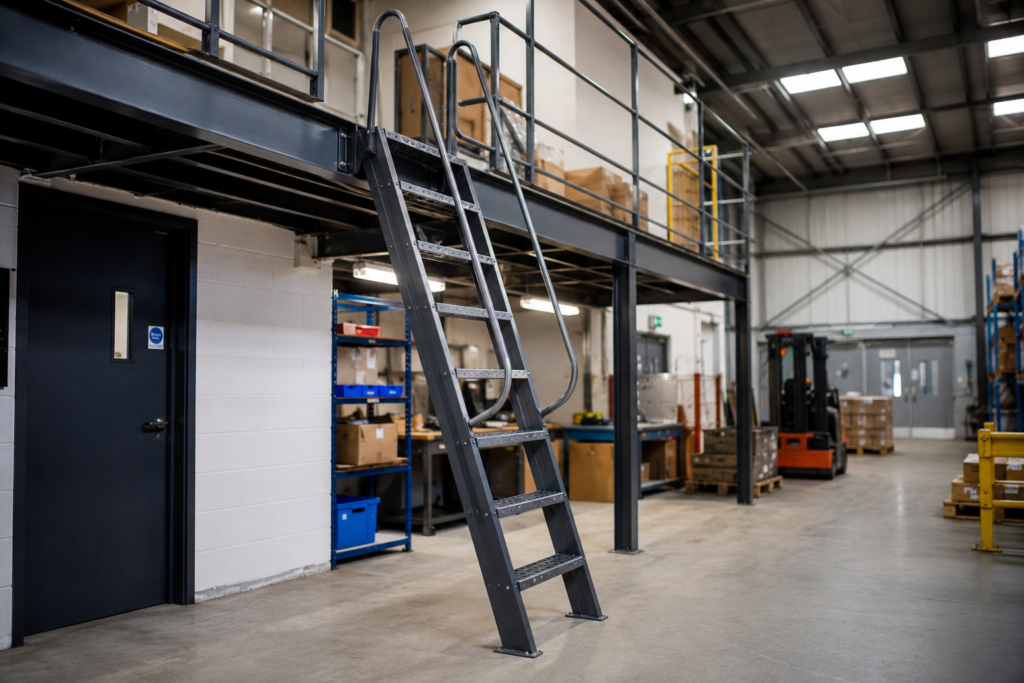
Plant rooms represent another common application. Commercial buildings often contain dedicated spaces housing heating systems, ventilation equipment, electrical switchgear, pumps and other essential building services. These rooms are frequently located above ceilings, on rooftops or within confined areas where conventional staircases simply would not fit. Ships ladders provide maintenance engineers with dependable access while making efficient use of restricted space.
Roof access is another area where ships ladders are widely installed. Many commercial buildings require authorised personnel to inspect air conditioning systems, solar panels, communication equipment or drainage installations positioned on rooftops. Safe access is essential, yet building owners often wish to avoid sacrificing internal floor space solely to accommodate occasional maintenance visits. A well-designed ships ladder offers an effective balance between accessibility and space efficiency.
Retail environments also benefit from compact access solutions. Larger shops frequently contain stockrooms positioned above the main sales floor or within split-level storage areas. Employees may need to retrieve products several times throughout the day while maintaining efficient movement around the premises. Ships ladders can provide straightforward access where the available floor area is too limited for conventional stairs.
Educational establishments sometimes use ships ladders to access plant rooms, theatre lighting galleries or specialist maintenance areas. These locations are usually restricted to authorised personnel rather than general building occupants, making ships ladders a practical solution where occasional access is required. Similar applications can be found within hospitals, universities and public buildings, where maintenance staff require safe routes to service equipment without disrupting day-to-day operations.
Commercial office developments increasingly incorporate mezzanine workspaces, archive storage and rooftop plant areas. As organisations seek to maximise usable office space, compact access systems become increasingly attractive. Rather than dedicating a significant portion of valuable office space to large staircases leading to areas that are only occasionally used, ships ladders offer an efficient alternative while maintaining appropriate safety standards.
Industrial processing plants often contain complex arrangements of tanks, conveyors, pipework and control equipment positioned at varying heights. Maintenance engineers regularly need to inspect valves, sensors and monitoring systems installed above ground level. Ships ladders allow safe access between different operational levels while fitting neatly within already congested industrial environments. Their straightforward design also makes them easier to integrate into existing facilities during refurbishment projects.
Agricultural buildings provide another excellent example. Grain stores, processing facilities, workshops and equipment storage buildings frequently require elevated access for inspections, maintenance or storage purposes. Since these structures are typically designed with practicality in mind, space-saving access solutions are particularly valuable. Ships ladders can provide reliable access without interfering with machinery movement or storage arrangements.
Energy facilities, including renewable energy installations, often require technicians to reach elevated equipment for routine inspections. Control platforms, monitoring stations and service areas may all benefit from compact ladder systems that minimise structural alterations while providing dependable access. Similar considerations apply within telecommunications facilities, where engineers need to reach equipment housed in restricted service areas.
One of the reasons ships ladders are so widely used is their adaptability. They can often be manufactured to suit specific floor heights, available spaces and operational requirements. Materials such as aluminium, galvanised steel and stainless steel allow installations to perform effectively in a wide range of environments, from indoor offices to outdoor industrial sites exposed to challenging weather conditions. This flexibility enables designers to select a solution that balances durability, maintenance requirements and project budgets.
Safety remains central to every installation. Although ships ladders occupy less space than conventional stairs, they must still be designed, manufactured and installed in accordance with relevant regulations and industry guidance. Features such as slip-resistant treads, secure handrails, appropriate rung dimensions and stable fixings all contribute to safe operation. Users should also receive suitable training where necessary, particularly if the ladder serves specialist industrial equipment or restricted-access areas.
Regular inspection and maintenance are equally important. As with any access equipment, routine checks help identify wear, damage or loose fixings before they become safety concerns. Employers should include ships ladders within their planned maintenance programmes and ensure they remain suitable for continued use throughout their service life.
It is also important to recognise that ships ladders are not appropriate for every situation. Buildings expecting high volumes of pedestrian traffic, public access or emergency evacuation generally require conventional staircases that comply with the relevant building regulations. Ships ladders are most effective where access is infrequent, space is restricted and authorised personnel are carrying out specific work-related activities.
As commercial and industrial buildings continue to evolve, making efficient use of available space remains a key design objective. Every square metre has value, particularly within warehouses, factories and commercial premises where operational efficiency directly affects productivity. Compact access systems allow designers to achieve this objective without sacrificing functionality or safety.
The widespread use of ships ladders across warehouses, manufacturing plants, offices, agricultural buildings, retail premises and maintenance facilities demonstrates their versatility. By providing dependable access where conventional staircases are impractical, they help organisations maximise space while supporting safe maintenance and operational activities. When correctly specified, professionally installed and properly maintained, ships ladders remain one of the most effective access solutions for environments where compact, reliable and safe vertical movement is essential.